
A structural shift underway
The decline in cleaner fish use is one of the most significant biological developments in Norwegian salmon farming in recent years.
The Norwegian Veterinary Institute has recommended phasing out cleaner fish use by 2029. In 2025, 19.1 million cleaner fish were stocked nationwide, compared with 60.9 million in 2019 and 24.1 million in 2024. This represents a 21% reduction in just one year.
At the same time, attention to cleaner fish welfare has increased significantly. In 2024, 12.7 million cleaner fish deaths were reported (Moldal T. et al., Fiskehelserapporten 2025), highlighting the significant welfare challenges associated with cleaner fish use.
What Stingray sites show
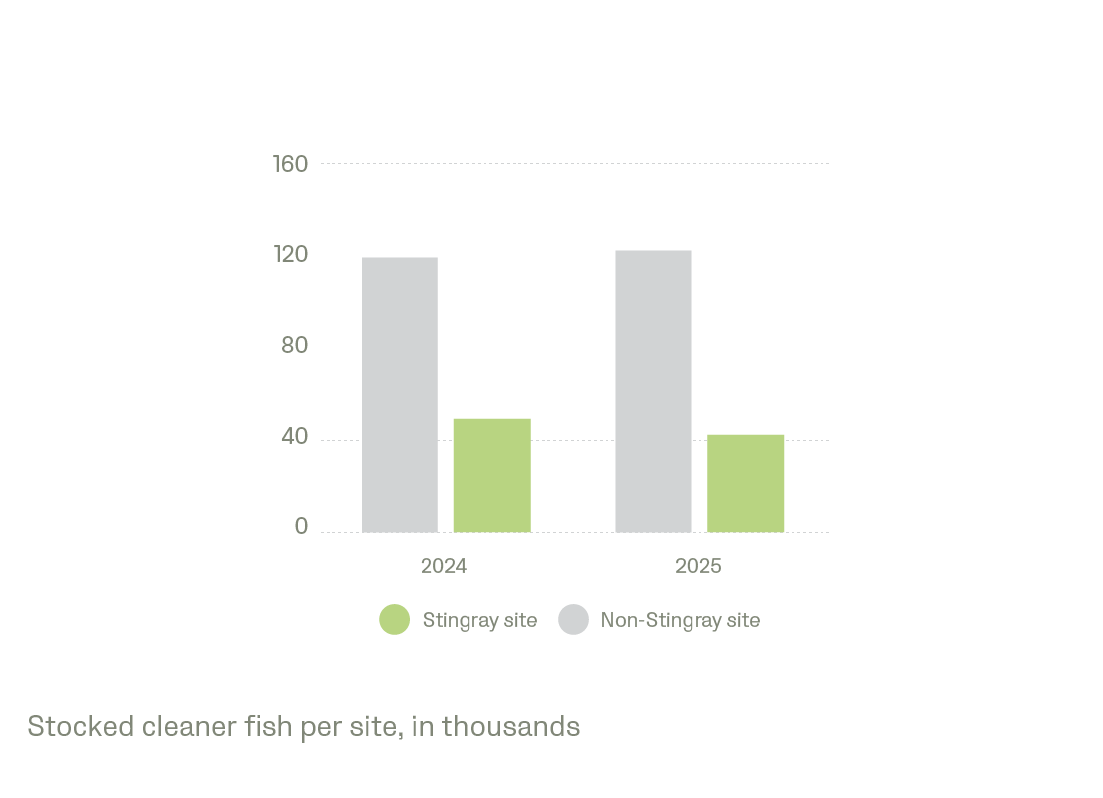
The difference is clear at sites equipped with Stingray technology. In 2025, Stingray customers accounted for approximately one quarter of Norwegian production weeks, but only around 2.3% of the cleaner fish deployed nationally.
Measured against production activity, this means that cleaner fish use at Stingray customers’ sites was roughly one tenth of the national average.
By the end of the year, only three sites equipped with Stingray technology were still combining cleaner fish with optical delousing. Like the Norwegian Veterinary Institute, the Norwegian Food Safety Authority also supports phasing out cleaner fish use by 2029. Stingray is actively contributing to this transition by offering an alternative to cleaner fish-based lice control.
“For every Stingray node deployed in a fish pen instead of cleaner fish, we save lives”
(Sebastiaan C. A. Lemmens, 2026)
Why it matters
Cleaner fish use and its welfare implications are receiving increasing attention through ASC certification, investor ESG assessments and biodiversity reporting under the ESRS framework.
The movement of wild-caught wrasse between regions also poses risks of disease transmission and potential impacts on local ecosystems. Using Stingray technology instead of cleaner fish can therefore reduce the need for cleaner fish-related procedures, lower the risk of disease transmission and simplify daily operations by allowing farm personnel to focus on a single fish species.
Reducing or phasing out cleaner fish use is therefore not only about improving fish welfare, but also about reducing the risk of negative impacts on biodiversity.
Using Stingray and want to document your cleaner fish reduction for reporting purposes? We can help.
Get in touch: sustainability@stingray.no