

The question farmers are being asked
Regulators, retailers and investors want to see quantified progress, not just intentions. For salmon farmers, one of the most significant emission sources is wellboat-based delousing. Estimating your avoided emissions from reduced treatment frequency has, until now, required assumptions. That’s changing.
160,000 tCO₂e potential annual saving from 50% reduction in reactive delousing operations across Norwegian aquaculture
(Terravera Foundation, 2026, medium scenario)
What Terravera modelled
In 2025, Stingray partnered with the Terravera Foundation to model the emissions impact of preventive optical delousing at sector scale.
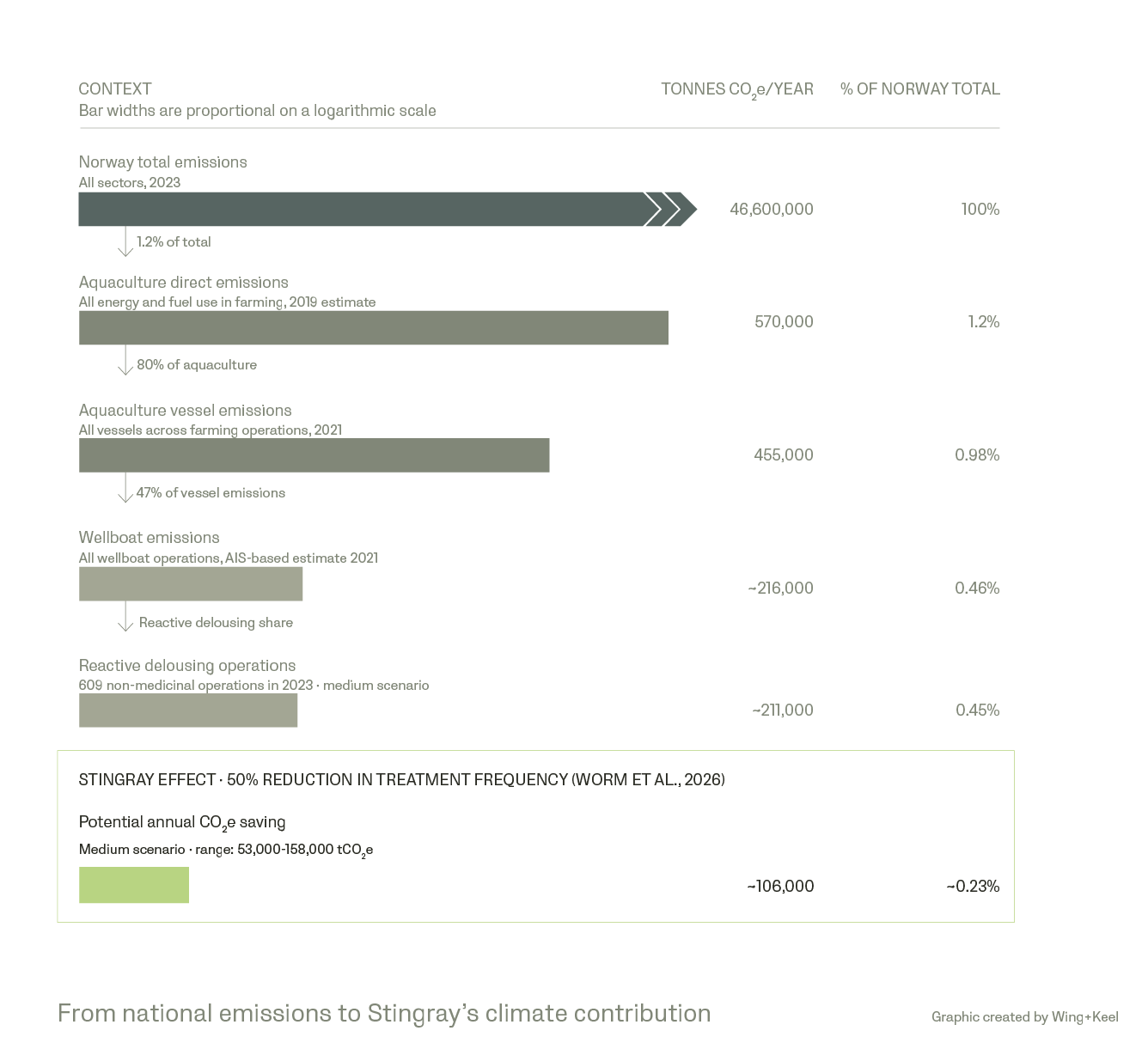
Working from tracked wellboat data, national treatment records and established energy conversion factors, the model estimated that reactive delousing operations across Norway generate approximately 211,000 tCO₂e per year.
This number reflects only average emissions from the wellboats, and doesn’t include the delousing equipment, service boats or any other related activities related to the reactive delousing. The majority of all wellboat emissions in aquaculture is due to delousing activities.
Based on a 50% reduction in treatment frequency, a figure supported by peer-reviewed research, the estimated potential annual saving from optical delousing is 106,000 tCO₂e (medium scenario, range 53,000–158,000 tCO₂e).
What this means
Emissions could be cut by 53,000-158,000 tonnes of CO₂ annually. This is equivalent to the annual emissions of approximately 26,000 Norwegians, or the emissions from about 14,800 flights between Oslo and Bergen (in 2025, there were approximately 12,700 flights between Oslo and Bergen).
And these are conservative estimates. If we take into account emissions associated with, for example, the production of wellboats, auxiliary equipment for these vessels, and service boats used for delousing, as well as chemical emissions, we’re talking much higher numbers.
If your sites use Stingray and your treatment frequency has fallen, you can calculate your own contribution using the per-operation emission factor from the Terravera model and your treatment history from Stingray Online. We can help you do this.
Want to know what Stingray’s sustainability data means for your own reporting?
Get in touch: sustainability@stingray.no